
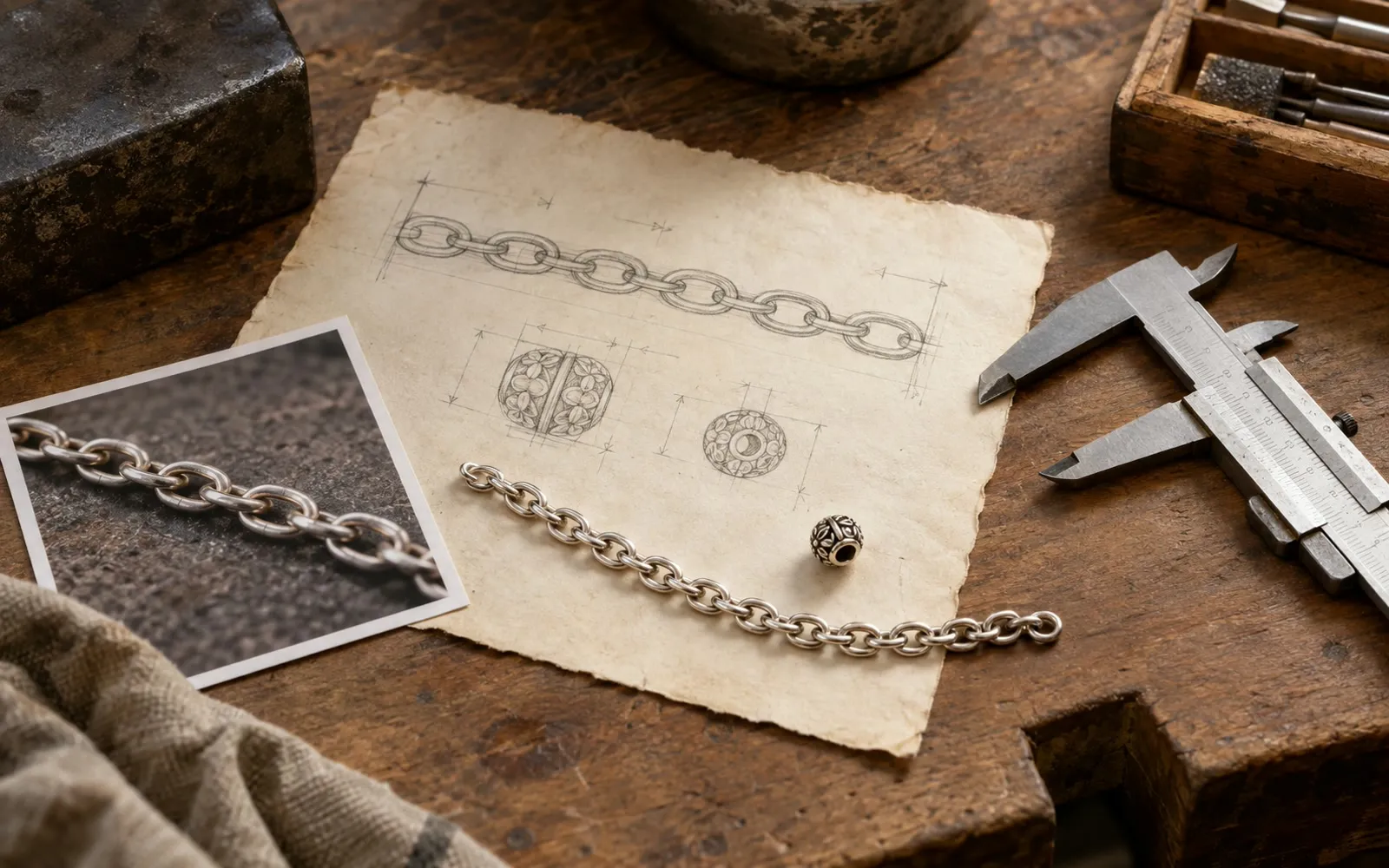
Most wholesale buying starts with a catalogue: you pick a design, ask for a quote, and order. Custom manufacturing works differently. You're asking a manufacturer to make something that doesn't exist yet - a chain in your exact length and gauge, a bead in your diameter, a clasp sized for your design - so the quality of what you get back depends heavily on how clearly you can describe it. This guide is for jewellery makers, retailers and exporters sourcing custom 925 silver components from Jaipur, one of India's best-known jewellery-making centres.
Custom manufacturing vs a one-off bespoke piece
These get confused, but they're different services. Bespoke jewellery usually means a single finished piece made for one person. Custom component manufacturing is a business-to-business service: a supplier makes chains, beads, clasps or earring parts to your specification, in the quantity you need, for you to build into your own designs or sell under your own label. Everything below is about the second kind.
When custom makes sense - and when the catalogue is faster
If a close match already exists in a supplier's standard catalogue, that's almost always the faster and simpler route - there's no development step, and you can order a sample straight away. Custom is worth it when nothing existing fits: a length, thickness or pattern that isn't listed, a component sized to a specific design, or a piece you want stamped with your own branding.
The spec sheet: what to prepare before you ask for a quote
A manufacturer can only quote and make what you can describe. Before you send a request, get these together:
- Product type - chain, bead, lock or clasp, jhumka, necklace, or another component.
- Dimensions - length, diameter, thickness or wire gauge, and a target weight if you have one. Weight matters because it's what the price is built on.
- A reference - a photo, a sketch, or a physical sample. A phone photo is enough; a sample or drawing with measurements is better.
- Finish and detailing - plain, textured, hand-detailed, and any surface you want. If it matters to the look, say so in words; a photo won't always show it.
- Quantity - even a rough figure helps, because it affects both the timeline and how the order is planned.
- Branding needs - whether you want a logo stamp, engraving or custom packaging (more on these below).
- Your firm and delivery address - so the quote can account for shipping within India or abroad.
The more of this you supply up front, the fewer rounds of back-and-forth you'll need, and the closer the first sample will be to what you pictured.
How a custom quote is priced
Silver is priced against the live market, so a fixed price list doesn't work for custom pieces. The usual structure is the day's silver rate applied to the piece's weight, plus making charges for the work involved. That's why dimensions and target weight matter so much in your request, and why a quote is confirmed against the rate on the day - our guide to the daily silver rate explains why wholesale pricing moves.
Samples and prototypes before the full run
For anything custom, ask for a sample or prototype before committing to a full order. It lets you check size, weight, finish and fit against your design while a mistake is still cheap to fix. A good manufacturer will expect this request rather than resist it.
Logo stamping, engraving and custom packaging
If you sell under your own brand, custom orders can carry more than your design. You can have your logo stamped or your marking engraved on the piece, and ask for custom packaging on the order. This is what's usually meant by OEM or private-label manufacturing: your design, your marking, your packaging. Mention what you need in the description of your request so it's included in the quote rather than added afterwards.
Timeline and payment: what to expect
Two things vary with every custom order, and any honest supplier will tell you so rather than quote a number before they've seen your request. Lead time depends on the size of the order - a small sample run and a large production order don't take the same time - so ask for the timeline in writing with your quote, and place custom orders well ahead of a season (see our wedding-season stocking timeline). Payment terms depend on the order and should be confirmed with the final price before the order is finalised.
What to check with any custom manufacturer
- Metal purity. Ask for the fineness number, not just "silver". Genuine sterling is 925 - see silver purity grades explained, and our guide to 925 hallmarking for what a stamp does and doesn't prove.
- A written confirmation of the spec - dimensions, finish, quantity and any branding - before production starts.
- A sample first, as above.
- Minimum quantities. Many manufacturers set a fixed minimum; ask up front so it doesn't surprise you later.
- Shipping and export. If you're outside India, confirm how the order will be shipped - our overview of exporting from India covers the basics.
How it works at Arun Silver
We manufacture custom 925 sterling silver chains, beads, locks and clasps, jhumke and necklaces in Jaipur, and can quote other silver components on request. There is no fixed minimum order quantity on custom orders - the same as our standard catalogue. Send your firm details, dimensions, a description, a reference photo if you have one, and your delivery address through the custom order form; we reply on WhatsApp with a quote against the day's silver rate. We make a sample or prototype before the full run, and can stamp your logo, engrave your marking and arrange custom packaging. We ship across India and export worldwide.
Not sure whether what you need should be custom or from stock? Browse the chains, beads or locks and clasps collections first, then start a custom order for anything that isn't there.