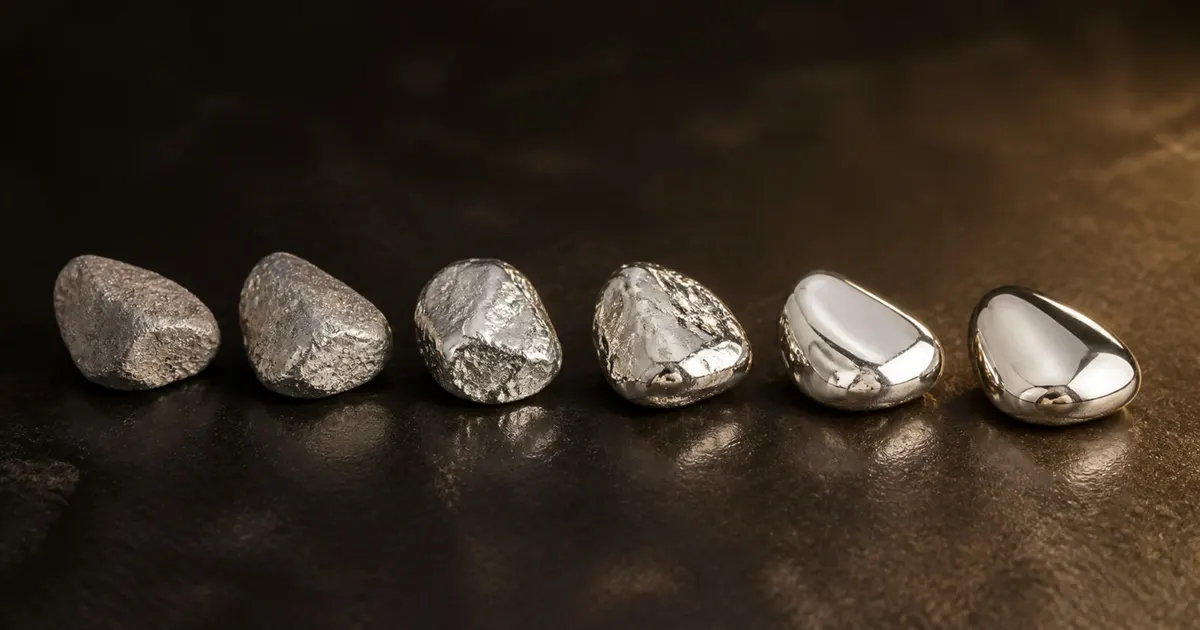
Silver purity is measured as fineness: the number of parts of pure silver in every 1,000 parts of the metal. So "925" means 925 parts silver in 1,000 (92.5%), and "999" means 999 in 1,000 (99.9%). It's a scale, not a yes-or-no question, and knowing where each grade sits - and why the jewellery trade landed on 925 - makes you a sharper buyer.
Silver purity chart
| Fineness | Silver content | Common name | Where you'll meet it |
|---|---|---|---|
| 999 | 99.9% | Fine silver | Bullion and coins. Very soft, so seldom used for everyday jewellery. |
| 958 | 95.8% | Britannia silver | A British standard. Uncommon in modern commercial jewellery. |
| 925 | 92.5% | Sterling silver | The international jewellery standard - the number stamped on almost every piece of silver jewellery. |
| 900 | 90% | Coin silver | Historically used for coinage and flatware. |
| 835 | 83.5% | - | A European standard, common in the Netherlands, Germany and Scandinavia. |
| 800 | 80% | Continental silver | The traditional minimum in Germany, Austria, Switzerland and Italy. Also widely hallmarked in India, especially on anklets. |
Below roughly 800, an alloy is mostly base metal and generally isn't sold as silver jewellery at all.
How is silver purity measured?
Gold is described in karats (24K is pure). Silver is described by fineness, in parts per thousand. Divide the number by ten to get a percentage: 925 is 92.5%, 800 is 80%. The remainder is other metal - in sterling silver, almost always copper.
That is why grades are simply called by their number: 999, 925, 800. When someone asks "how is silver graded?", the answer is one number - the fineness.
What does 999 silver mean?
999 silver, also called fine silver or "three nines fine", is 99.9% pure silver. It is the purest grade in everyday jewellery and bullion trade, and the highest on India's BIS hallmark list (a few mints refine bullion further, to 99.99%). Even fine silver isn't literally 100%: the last 0.1% is trace impurities.
Pure silver is soft. It dents, scratches and loses its shape under normal wear, which is why 999 is the grade for bullion bars and coins rather than for clasps, hooks or beads that have to hold their form.
999 vs 925: a gram of 999 holds more silver than a gram of 925, but the extra purity costs strength. Jewellery makers choose 925 because the 7.5% of other metal is what lets a piece keep its shape, hold fine detail and survive daily wear.
Sterling silver grades: is there more than one?
Sterling silver is a single grade: 925. People searching for "grades of sterling silver" usually mean the wider purity scale in the chart above.
One variation worth knowing is Argentium silver, a proprietary alloy that replaces some of the copper with germanium. It is sold as Argentium 935 (93.5% silver) and Argentium 960 (96% silver), both above standard sterling, and it resists tarnish better. It is a different alloy from ordinary 925, so a plain "925" stamp does not mean Argentium.
Silver purity grades in India: the BIS hallmark
India's Bureau of Indian Standards (BIS) has run a silver hallmarking scheme since 2005. Since 1 September 2025 it works under a revised standard, IS 2112:2025, which lists seven purity grades:
| BIS grade | Silver content |
|---|---|
| 800 | 80% |
| 835 | 83.5% |
| 925 | 92.5% |
| 958 | 95.8% (new in the 2025 revision) |
| 970 | 97% |
| 990 | 99% |
| 999 | 99.9% (new in the 2025 revision) |
A BIS silver hallmark has three parts: the BIS standard mark with the word "SILVER", the purity grade, and a six-digit HUID (Hallmarking Unique Identification) code. Anyone can look a hallmarked piece up in the BIS Care app to see its article type, purity grade, hallmarking date, testing centre and the jeweller's registration number.
The scheme itself is still voluntary. As of the Ministry of Consumer Affairs' December 2025 update, HUID is mandatory only for silver articles that are hallmarked, and in June 2026 the BIS Director General said the bureau was still examining the framework for making hallmarking mandatory. In the first three months of the HUID system, 925 and 800 made up nearly 90% of the silver articles hallmarked.
Silver purity marks: how to read a stamp
You'll see purity marked as "925", ".925", "S925" or "Sterling Silver" spelled out. All of them are a claim of the same 92.5% standard. A BIS hallmark is a different thing: it is applied at a recognised hallmarking centre and can be checked against the HUID, whereas a plain stamp on its own is the maker's claim. Because hallmarking is voluntary, it's worth asking any supplier what is simply stamped and what is hallmarked. Our companion guide to 925 hallmarking covers what to check on a piece.
Why the trade settled on 925
Sterling silver's 7.5% copper is a deliberate engineering trade-off. Pure silver is too soft to hold fine detail - granulation, filigree, prong settings, clasps that must spring back into shape. Adding copper hardens the alloy enough to survive daily wear and intricate work while keeping the colour and lustre close to pure silver. Go much below 925 and the alloy starts to look visibly duller or more yellow as the copper share rises. Stay at 925 and you get the best practical balance of durability and appearance the trade has landed on over centuries. For more on telling real sterling from look-alikes, see sterling silver vs silver plated.
What this means for a wholesale buyer
When you compare components across suppliers, confirm the purity grade first and don't assume it from the word "silver". Ask for the fineness number, not just "is this silver". Every design in our catalogue is genuine 925 sterling silver - the same standard whether you are looking at a plain jump ring or a hand-detailed Bali Beads focal piece - so the purity question has one answer across the whole range. If you need a component in 925 made to your own dimensions, see our custom orders.
Before your next wholesale inquiry, read how to evaluate a supplier for practical checks to use alongside the purity grade.
For components in the sterling grade discussed here, browse 925 silver chains and compare the available styles for your jewellery line.
Frequently asked questions about silver purity
What does silver fineness mean?
Fineness is the number of parts of pure silver in every 1,000 parts of the metal. Divide the fineness number by ten to get the silver percentage.
What purity is sterling silver?
Sterling silver is 925 fineness: 92.5% pure silver and 7.5% other metal, usually copper.
How does 999 silver differ from 925?
999 silver, also called fine silver, is 99.9% pure silver. It is purer, not better for jewellery: it is the grade for bullion bars and coins rather than for clasps, hooks or beads that have to hold their form, so 925 is the practical standard for jewellery and components.
Is sterling silver more than one grade?
Sterling silver is a single grade: 925. Argentium 935 and 960 are different alloys from ordinary 925.
Which grades does IS 2112:2025 define?
IS 2112:2025 lists seven silver purity grades: 800, 835, 925, 958, 970, 990 and 999.
Is silver hallmarking mandatory in India?
As of June 2026, the BIS silver hallmarking scheme is voluntary. HUID is mandatory only on silver pieces that are hallmarked.
Does a 925 stamp mean a piece is BIS-hallmarked?
No. A 925 stamp is a claim of 92.5% silver. A BIS hallmark is applied at a recognised hallmarking centre and can be checked against the HUID.
How can I check a hallmarked piece?
Look up its HUID in the BIS Care app. The app shows the article type, purity grade, hallmarking date, testing centre and the jeweller's registration number.
Sources: Press Information Bureau, Ministry of Consumer Affairs - voluntary silver hallmarking with HUID from 1 September 2025 (4 September 2025) and update on HUID for silver jewellery (4 December 2025).