
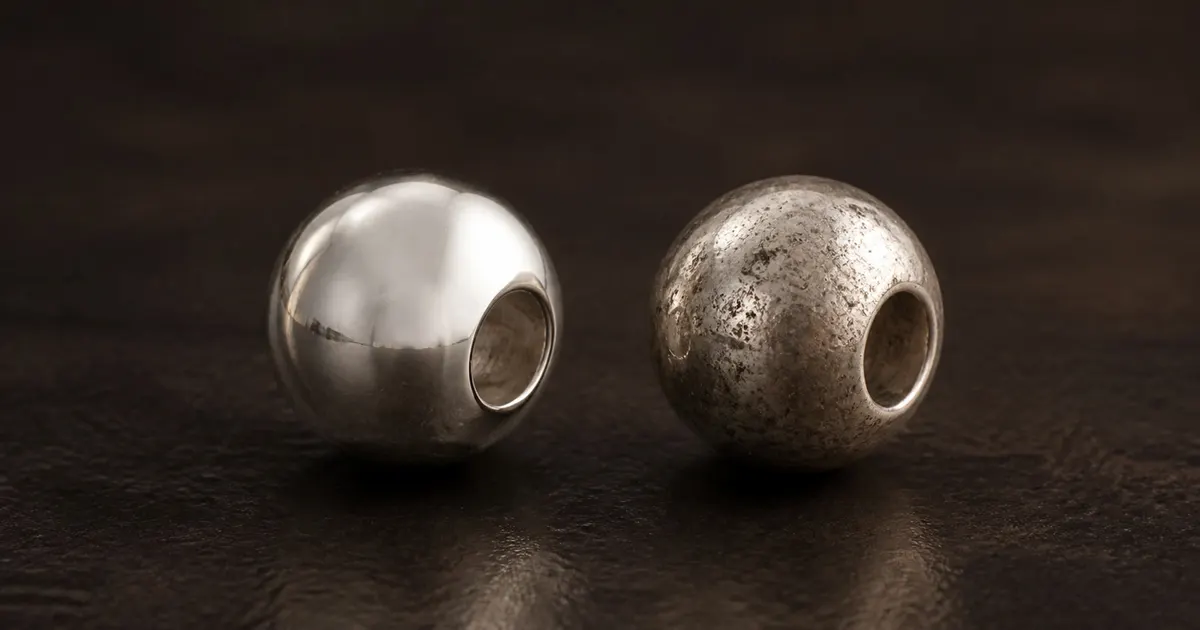
Scroll through enough wholesale listings and you'll see "silver," "silver-plated," and "silver-toned" used almost interchangeably - but these describe genuinely different products, at genuinely different price points, with genuinely different resale risk. Knowing the difference before you buy protects both your margin and your customers' trust.
What each term actually means
- Solid sterling silver (925) - the metal is silver alloy all the way through, at 92.5% purity. See our purity grades guide for the full scale.
- Silver-plated - a thin layer of silver (or occasionally silver-coloured alloy) electroplated over a base metal core, usually brass, copper, or a copper alloy. The base metal never actually leaves - it's just coated.
- Silver-toned / silver-coloured - often no actual silver content at all; a base metal or alloy finished to look silver-coloured, sometimes without any plating layer.
Why the difference shows up over time, not immediately
A silver-plated piece can look identical to solid sterling silver on day one - that's exactly what plating is designed to do. The difference shows up with wear: plating is a thin surface layer, and normal handling, moisture, and skin contact gradually wear it thin at high-contact points (clasp edges, ring interiors, chain links that rub against each other). Once the plating wears through, the base metal underneath is exposed - a visible colour change, sometimes with skin discolouration or irritation from the base metal, that a solid sterling silver piece simply doesn't experience (tarnish on solid sterling is a surface oxidation that polishes back off; a worn-through plating layer doesn't come back).
Why this matters specifically for resale
- The failure happens on your customer's watch, not the supplier's. If you resell a plated piece as "silver" without disclosure and it wears through in a few months, that complaint lands on you, not your supplier.
- Price comparison across suppliers is meaningless without knowing which product you're comparing. A silver-plated component will always be cheaper per piece than solid sterling - that's not a better deal, it's a different product.
- Repeat business depends on durability living up to the claim. A customer who buys "silver" jewellery that visibly degrades within a wear season is unlikely to buy from you again, even if the fault traces back to your supplier's sourcing.
How to tell them apart before you commit
Ask the supplier directly and specifically - "is this solid sterling silver or silver-plated" is a fair, normal wholesale question, and a supplier who hedges on it is worth probing further. A genuine 925 stamp is a good sign but isn't foolproof on its own (see our hallmarking guide for what a verifiable hallmark actually includes); requesting a sample before a bulk order, as covered in our guide to sample orders, is the most reliable way to physically check what you're buying before you commit to volume.
Every component across our catalogue - from Bali Beads to the plainest jump ring in the Findings collection - is solid genuine 925 sterling silver, not plated. There's no plated tier in what we sell, so the material question has one consistent answer across the whole range.