
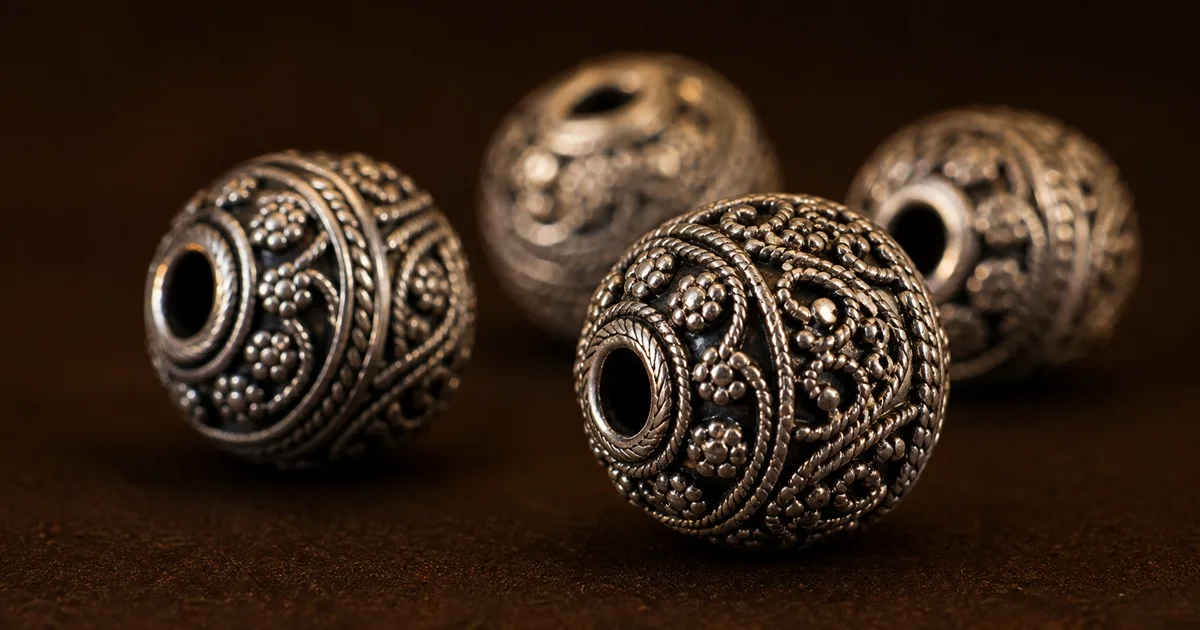
"Bali beads" is one of those terms that gets used loosely across the jewellery trade - sometimes accurately, sometimes as a catch-all for anything with an ornate, hand-worked look. For a wholesale buyer deciding what to stock, it's worth knowing what the term is actually supposed to mean, because the difference shows up directly in your margins and your customers' expectations.
The tradition behind the name
Balinese silversmithing is a genuine, centuries-old craft tradition centred on the village of Celuk in Gianyar regency, Bali, Indonesia. Silversmiths there developed a distinctive style built around two techniques: granulation (fusing tiny silver spheres onto a surface to build texture and pattern) and filigree (twisting and soldering fine silver wire into lace-like designs). Genuine Bali-style beads combine these techniques to produce a bead surface with real depth - raised dot patterns, twisted wire borders, and small soldered details that catch light differently from a smooth or machine-stamped surface.
The style spread well beyond Bali itself decades ago, and today "Bali beads" is used industry-wide to describe this decorative approach regardless of exactly where a given batch was produced - including in India's own silver jewellery manufacturing centres, which have developed strong expertise in the same granulation and filigree techniques. What actually matters for a wholesale buyer isn't the geographic label so much as whether the workmanship is genuinely hand-detailed or a mould-cast copy of the look.
What to check before ordering wholesale
- Weight and size are stated precisely, not "approximately," wherever a supplier has them on record. Hand-detailed beads vary slightly piece to piece, but a supplier who can't or won't give you an exact weight and size per design when asked is a red flag - see our Bali Beads catalogue, where designs list exact weight in grams and size in millimetres wherever that data has been recorded, and we'll confirm the rest on request.
- 925 stamped or otherwise verifiable. Genuine sterling silver is 92.5% pure silver alloyed with other metals for durability, and should be marked accordingly - see our companion guide on 925 hallmarking for what to look for.
- Consistent detailing under magnification. Ask for close-up photos or a physical sample. Cast copies of granulation work often show slightly blurred, uniform "dots" from a mould, where hand-applied granulation has small natural irregularities.
- A supplier who can answer sourcing questions directly. Wholesale buying is a relationship, not a one-off transaction - a supplier who responds clearly to specific questions about a design is one you can build repeat orders with.
Where Bali beads fit in a jewellery line
Because of their texture and visual weight, Bali-style beads work best as focal points - a single statement bead on a cord necklace, spacer beads between simpler elements on a bracelet, or as the centrepiece of drop earrings. They pair well with plainer components (jump rings, clasps, simple spacer beads) rather than competing with other heavily detailed pieces in the same design.
If you're building out a jewellery line and want to see the range available, browse the full Bali Beads collection - all 212 designs are genuine 925 sterling silver with hand-detailed granulation and filigree work, with exact weight and size listed wherever we have it on record, so you can plan a design and its cost basis before you order. Looking specifically for the bead caps that finish a design at either end, see our separate Bali Beads Caps collection.