
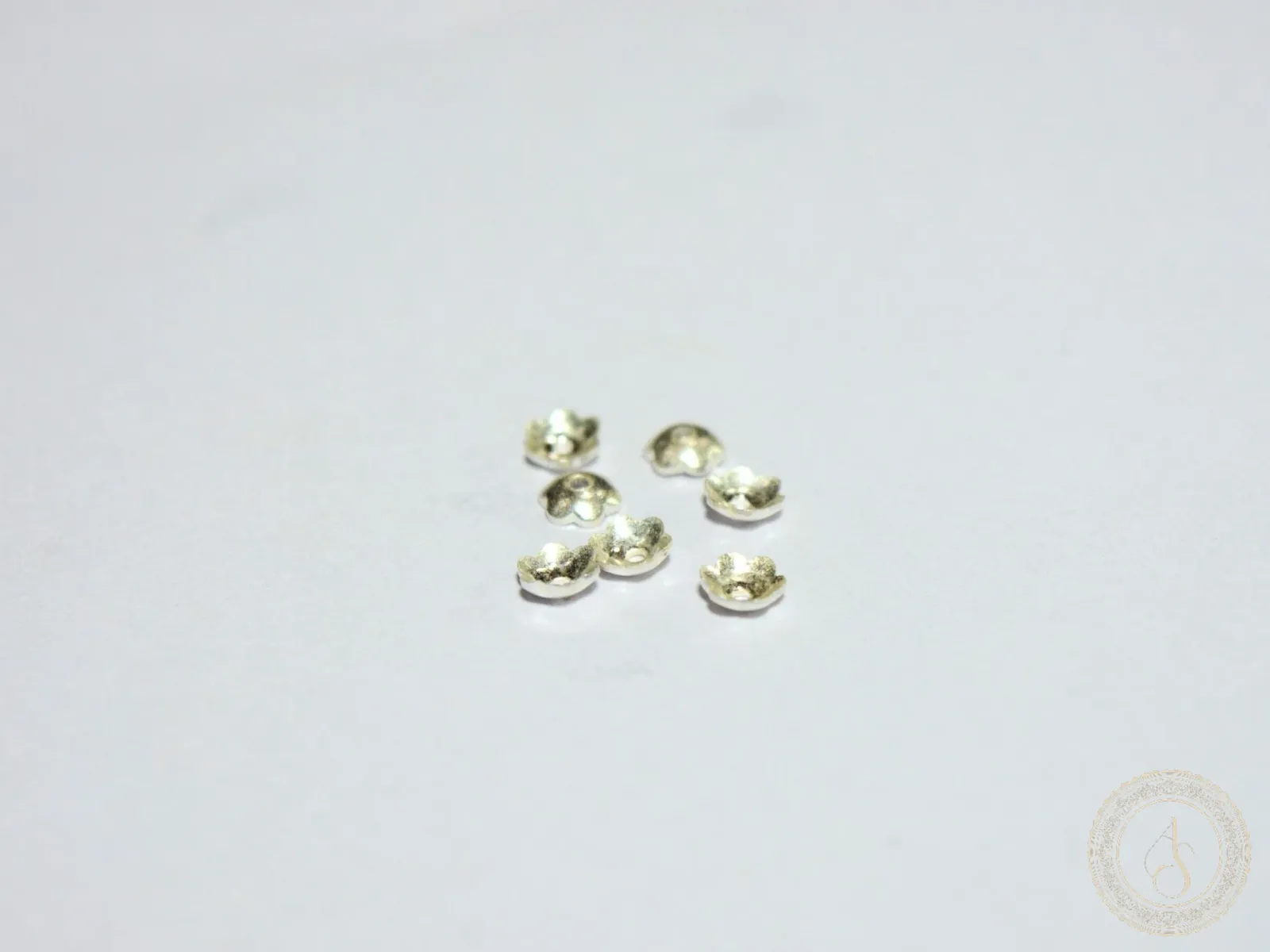
Spacer beads and bead caps are support components - they're not usually the focal point of a design, but getting their size and placement right is often what separates a piece that reads as deliberately designed from one that looks like beads were simply threaded on in whatever order they came in. Neither gets much attention in buying guides, so here's a practical look at how to think about sizing and pairing them.
What a spacer bead actually does
A spacer bead's job is rhythm and separation: a small, usually plain bead placed between larger focal beads to create visual breathing room and set a consistent spacing along the strand. Because it's meant to recede rather than compete for attention, a spacer is almost always smaller and plainer than the beads it's separating - if a spacer is as detailed as the focal bead next to it, it stops reading as a spacer and starts competing with the design instead.
What a bead cap actually does
A bead cap sits at either end of a focal bead, partially covering it like a small dome or cone. It does two things at once: it protects and frames the edge of the bead's drill hole (which is often the least finished part of a bead), and it adds a second layer of visual detail - the transition from cap to bead becomes part of the design rather than a plain hole edge. Because a cap has to physically sit against the bead's end, its diameter needs to be sized close to the bead's own diameter - a cap that's too small perches awkwardly on top instead of framing the curve, and one that's too large overwhelms the bead it's meant to be finishing.
Sizing them against your focal bead
As a general rule of thumb: match a bead cap's rim diameter to be equal to or very slightly larger than the diameter of the bead it will cap, so the cap's edge follows the bead's curve rather than sitting flush against a flat gap. Spacer beads work the opposite way - deliberately smaller than the focal bead, often by half or more, since their job is to be a quiet interval rather than a second point of focus.
How many spacers, and where
There's no fixed rule, but a common approach is to use spacers in pairs flanking each focal bead (spacer-focal-spacer), which gives every focal point a consistent visual frame along the strand, rather than scattering spacers unevenly. For a longer strand with several focal beads, keeping the spacer count and placement consistent between each focal point is usually what makes a finished piece look intentional rather than improvised.
Sourcing them wholesale
Our Plain Beads collection runs to 82 designs and our Plain Beads Caps collection to 12, both in genuine 925 sterling silver, priced against the day's silver rate with no fixed minimum order quantity - so you can source exact quantities to match a specific design rather than buying in preset lots. If you're pairing spacers or caps against our Bali Beads range instead, our Bali Beads Caps collection is built specifically to match that collection's own sizing.