
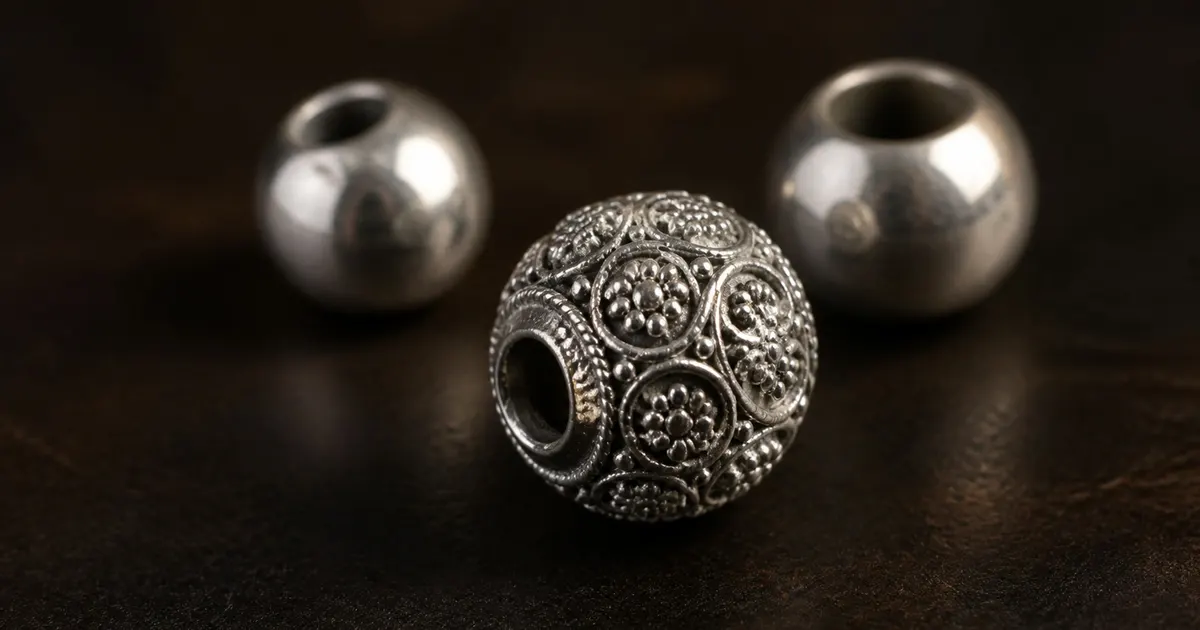
Two components can both be genuine 925 sterling silver, similar in size and weight, and still land at noticeably different price points wholesale. Production method - specifically, how much hand-finishing work went into the piece - is usually the reason, and understanding it helps you read a price list more intelligently.
Casting: consistency at scale
Casting produces a piece by pouring or injecting molten silver into a mould, then finishing the resulting piece (trimming, polishing, sometimes light hand-detailing). It's the standard method for producing simpler, repeatable shapes - plain beads, bead caps, basic clasps, standard jump rings - at consistent quality and a lower per-piece cost, because the mould does most of the shaping work rather than a craftsperson doing it by hand each time. Cast pieces from a well-maintained mould are highly consistent piece to piece, which matters if you need matching components in volume for assembly.
Browse our plain silver beads for simpler shapes to compare with the hand-detailed Bali Beads collection.
Hand-finishing: character at a cost
Hand-finished work adds labour-intensive detailing on top of (or instead of) the base casting - granulation (fusing tiny silver spheres by hand), filigree (twisting and soldering fine wire), individually applied texturing, or fully hand-fabricated pieces built from wire and sheet rather than cast at all. This is the technique behind genuine Bali-style beadwork. It costs more per piece because it takes a skilled craftsperson real time per unit, and it typically shows small natural variation piece to piece - a feature of handwork, not a defect (a mould-cast imitation of the same look often looks suspiciously uniform under close inspection, which is itself a tell).
Neither method is "better" - they solve different problems
- Casting wins when you need volume, consistency, and lower cost-per-piece - the connective and structural components of a design (see our findings guide).
- Hand-finishing wins when the piece is meant to be a focal point that customers notice and pay a premium for - the visual centrepiece of a necklace or earring.
Most well-planned jewellery lines use both deliberately: cast components for the structural, high-volume parts of a design, hand-finished pieces as the focal element that justifies a higher retail price - the same logic covered in our Simple Beads vs Bali Beads comparison.
What to ask a supplier about production method
If a per-piece price seems unusually low for a design that looks hand-detailed in photos, or unusually high for a simple shape, production method is a reasonable thing to ask about directly - a supplier should be able to tell you plainly whether a given design is cast, hand-finished, or a combination of both, since it directly explains the pricing. Weight and finish quality in hand are the most reliable practical check; requesting a small sample before a bulk order (see our guide on sample orders) lets you inspect this directly rather than relying on photos alone.
Across our own catalogue, the Bali Beads collection is our hand-detailed, granulation-and-filigree work; the rest of the range covers the simpler, structural components a design needs to come together. Ask us directly about any specific design's production method - we're glad to answer before you commit to a quantity.