
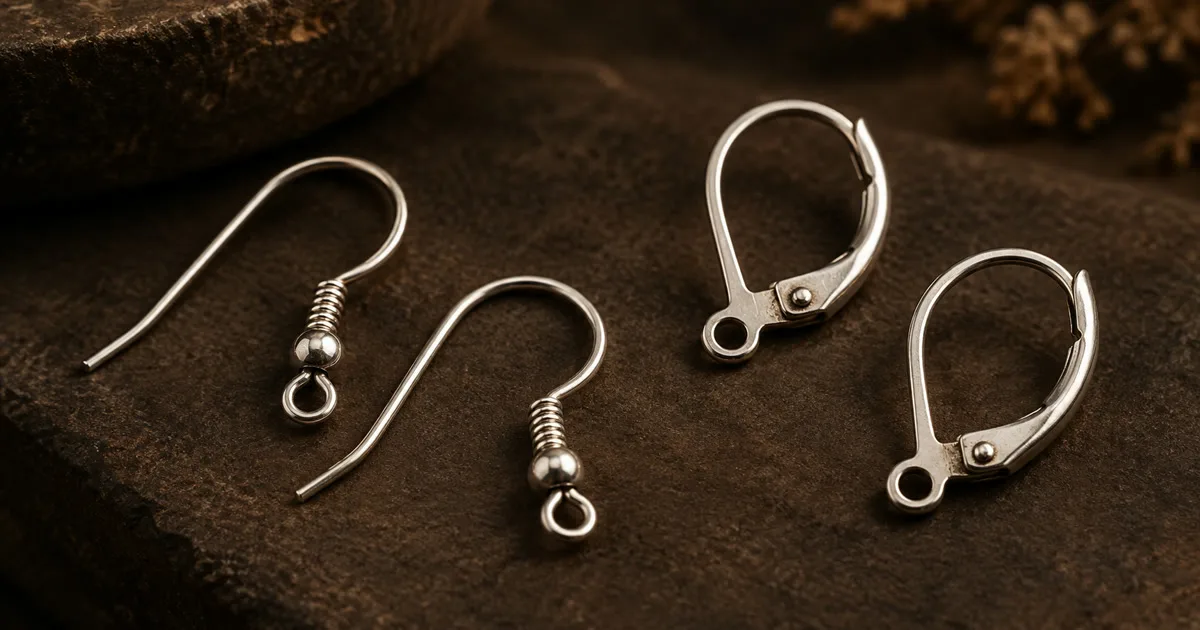
Earring findings get less attention than the decorative piece hanging off them, but the mechanism you choose changes how a design actually wears - not just how it looks in a product photo. Our Locks & Clasps collection carries real examples of each type below.
Fish-hook ear wires
A simple curved wire that hooks through the earlobe - the lightest-feeling of the three mechanisms here, and the easiest to put on and take off quickly. The tradeoff is security: a fish hook can slip out more easily than a closed mechanism, particularly during sleep or active wear. Best suited to statement or occasional-wear earrings rather than everyday pieces. See AS-LK-006 and AS-LK-007.
Lever-back ear wires
A hinged wire with a small lever that locks closed against the back of the earlobe - genuinely more secure than a plain fish hook, since the earring can't simply slide back out the way it went in. Slightly more fiddly to fasten than a push-back, but the added security makes it a common choice for heavier or dangle-style earrings, where extra weight makes a looser mechanism more likely to work its way loose over a day. See AS-LK-005.
Push-back (post) findings
A straight post through the ear, held in place by a separate friction-fit back piece pushed on afterward - the standard mechanism for stud-style earrings rather than dangles. Secure for everyday wear, simple to manufacture consistently, and the natural choice when the earring itself is meant to sit flush against the ear rather than swing. See AS-LK-001.
Choosing by earring weight and wear pattern
- Light, everyday studs: push-back.
- Heavier dangle or drop earrings: lever-back - the extra security matters more as weight increases.
- Statement or occasional-wear pieces where quick on/off matters: fish hook.
Pairing the right finding with the right design isn't just cosmetic - it's the difference between a piece that gets complimented and one that gets lost. Browse Locks & Clasps and build your inquiry list across whichever mechanisms your line needs.